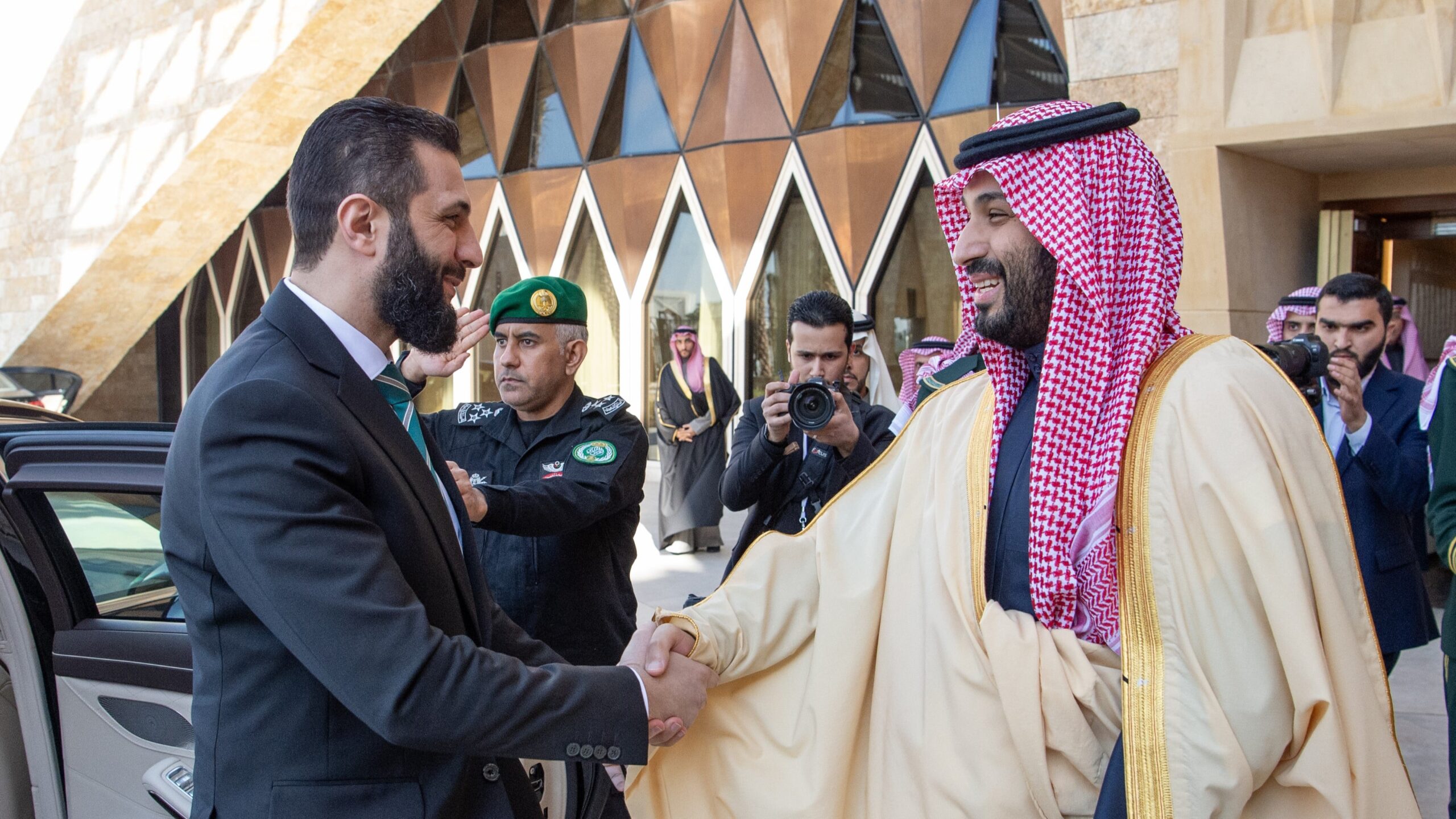
Syria’s interim president, Ahmed al-Sharaa, chose the Saudi Arabian capital Riyadh for his first international visit. The visit commenced on Feb. 2, with al-Sharaa and Syrian Foreign Minister Asaad Hassan al-Shaibani landing in Riyadh aboard a Saudi private jet. The visit was highly significant and marked a key moment for the new Syrian government’s quest for international recognition following the fall of the Bashar Assad regime. By opting for Saudi Arabia as his first stop, al-Sharaa clearly signals an intent to rejuvenate diplomatic ties between the two nations and securing economic support from the kingdom.
In Riyadh, al-Sharaa engaged in talks with Saudi Crown Prince Mohammed bin Salman (MBS). Bilateral discussions focused on critical issues like securing Syria’s peace and stability, economic revitalization, and easing international sanctions on the country.
Al-Sharaa’s visit highlighted Syria’s ambition to fortify its relations within the Arab world, especially with a key player like Saudi Arabia. This engagement appears to be a strategic move by Syria to re-integrate into the Arab community, distancing itself from previous regime allies such as Iran and Russia. This diplomatic outreach could enhance the new Syrian government’s position and garner more support on both regional and global platforms.
Saudi policy
Politically, Saudi Arabia is making a renewed effort to engage with Syria and aims to restrict Iranian influence in the region. For years, Iran has been a staunch supporter of the Assad regime, fostering networks within Syria, which has been a major regional concern for Saudi Arabia.
One indicator of Saudi Arabia’s ongoing unease towards Iran is evidenced by Saudi Foreign Minister Faisal bin Farhan’s visit to Lebanon. In both Syria and Lebanon, the declining influence of Iran — particularly Hezbollah in Lebanon — presents opportunities for Saudi Arabia to play a greater political and economic role.
With the new Syrian government committed to distancing itself from Tehran, Saudi leaders are supportive of this shift, viewing it as a cornerstone for their regional strategy.
Political reasons
Iran’s influence in Syria grew significantly under the Assad regime, especially during the civil war when Iran provided substantial support to Assad. This entrenched presence became a major concern for Gulf states, who initially supported Assad in hopes of freeing Syria from Tehran’s control. However, the Gulf countries’ strategy to counter Iranian influence backfired when the Assad regime weakened, leading to a decrease in both Iranian and Russian influence — an outcome that contradicted their original objective.
In the contemporary political landscape of the Middle East, the Gulf states are now directing their support toward the new Syrian administration to curb Iran’s influence in the country. The interim government has taken a firm stance against Iranian influence, a policy that has gained favor with Saudi authorities. This shift in Syrian politics provides an opportunity for the Gulf states to build stronger ties with Syria, particularly as the new regime is aligning more closely with Türkiye, a regional power known for its opposition to Iranian influence in Syria.
Economic reasons
While the political motivation for Gulf states like Saudi Arabia in Syria is centered on curbing Iran’s influence, another key factor is economic: the opportunities and willingness to participate in Syria’s reconstruction process. Recent diplomatic visits and contacts suggest that al-Sharaa’s administration believes Syria’s recovery depends on securing Gulf funding for reconstruction and infrastructure development.
For their part, the Gulf countries see opportunities in investing in Syria’s reconstruction efforts, which would not only help rebuild the country but also create a more favorable economic environment. Additionally, nations like Saudi Arabia are keen to see all U.N. sanctions against Syria lifted. While some sanctions have been eased, their complete removal depends on meeting specific criteria. This situation motivates Syria to seek out partners who can lobby for the complete removal of these sanctions, thus boosting economic cooperation.
Security reasons
Security considerations are also critical in shaping this relationship. The new Syrian administration must work to prevent the return of conditions that could fuel extremism or instability. Gulf states, wary of another wave of violence, aim to promote trust and stability by collaborating closely with Syria on security issues. Their involvement is intended to help manage potential threats and prevent further unrest during Syria’s transitional phase.
In conclusion, Syria’s re-engagement with the Gulf is built on three foundational pillars: political realignment to reduce Iranian influence, economic support for national rebuilding, and security cooperation to ensure regional stability. This comprehensive approach, emphasized during recent dialogues in Riyadh, reflects the Gulf states’ commitment to partnering with Syria as it navigates into a new era.
Bir yanıt yazın